
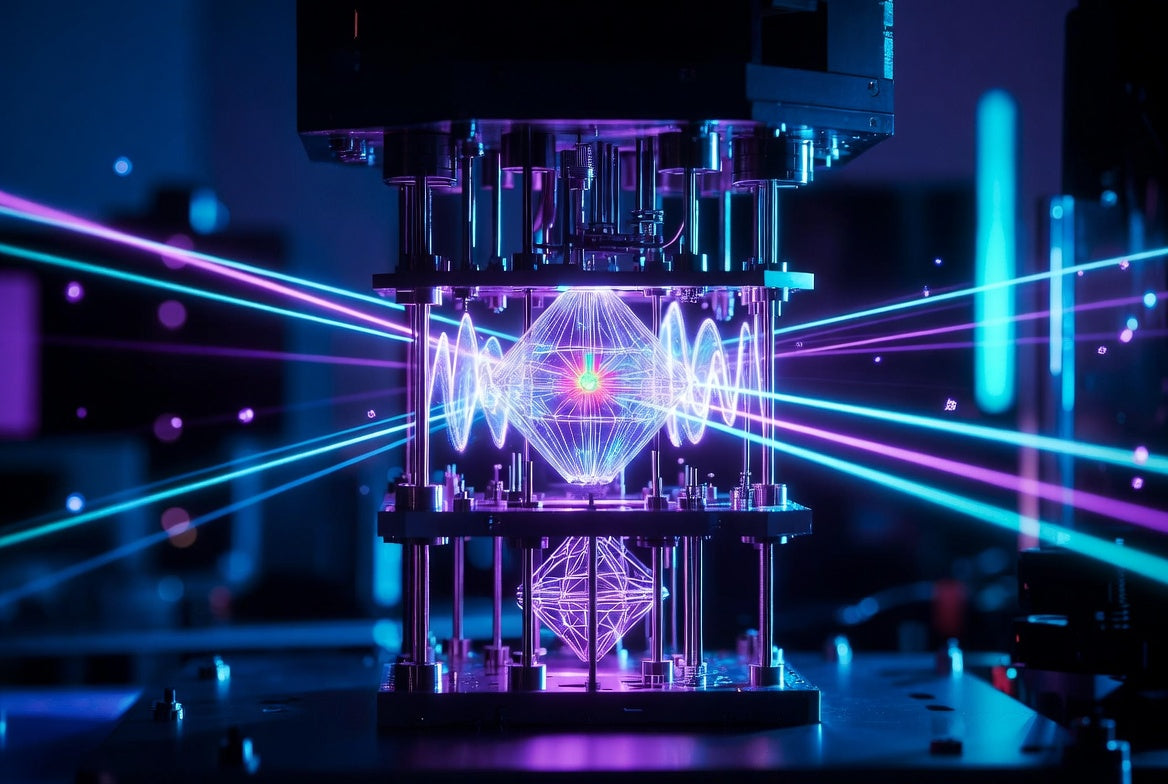
Hybrid Quantum-Acoustic Platforms Emerge as Practical Bridge for Quantum Networking and Sensing
Two closely timed breakthroughs in May 2026 are sharpening focus on quantum acoustics and optomechanics as viable engineering layers for hybrid quantum systems. Harvard researchers demonstrated the first controlled interaction between a single phonon and a single atomic spin qubit, while a Caltech-Stanford collaboration advanced nonlinear phonon behavior in NEMS devices using intrinsic material properties.
These developments address a persistent pain point for quantum hardware teams: reliably interfacing disparate qubit modalities—superconducting, photonic, trapped-ion, or neutral-atom—without losing coherence or introducing excessive overhead.
Harvard’s Spin-Phonon Coupling Milestone
On May 6, 2026, a team led by Marko Lončar at Harvard’s John A. Paulson School of Engineering and Applied Sciences published results in Nature showing strong coupling between a single phonon (quantum of mechanical vibration) and a diamond color-center spin qubit.
By fabricating a nanometer-scale mechanical resonator directly around an NV or similar color center in diamond, the researchers achieved sufficient spin-phonon interaction strength for quantum information storage and transfer. This is the first time a single quantum of sound has been coherently coupled to a single atomic spin in this manner.
For researchers working on quantum networks, this offers a new pathway for transduction—converting quantum states between optical photons (good for long-distance transmission) and more stationary memories. Diamond’s established strengths in photonic interfaces and spin qubits make this particularly actionable.
Caltech-Stanford NEMS Advance
On May 22, physicists at Caltech and Stanford reported in Nature Physics on nanoelectromechanical systems (NEMS) where phonons exhibit intrinsic quantum nonlinearity without external pumping. This enables single-phonon-level control and manipulation using the material properties alone.
The work positions quantum acoustics as a complementary domain to quantum optics, with potential for compact quantum memories, sensors, and hybrid processors that operate at more accessible conditions than pure cryogenic superconducting setups.
Why This Matters for Labs and Photonics Teams
Quantum hardware developers have long struggled with modality mismatches. Photonic qubits excel at communication but are hard to store; spin qubits offer long coherence but need efficient I/O; mechanical systems can bridge them with relatively robust interfaces.
These acoustic platforms leverage existing expertise in:
- Precision laser systems for optical readout and control of mechanical resonators
- Diamond photonics and color-center fabrication (already mature in many university and national labs)
- Cryogenic optomechanics and low-loss packaging
Lab managers and optical engineers will recognize the implications for instrumentation: tighter requirements for laser linewidth and stability when driving phonon modes, improved integration of mechanical resonators with photonic waveguides, and new test protocols for hybrid devices.
National labs like Sandia and Los Alamos, which already run strong programs in quantum sensing and transduction, are well-positioned to build on this. Photonics companies supplying components for diamond nanophotonics, acousto-optic modulators, or high-stability lasers are likely to see increased demand as teams move from proof-of-concept to repeatable device engineering.
Practical Outlook
This isn’t abstract theory. The Harvard result explicitly targets quantum communications applications, while the Caltech-Stanford work emphasizes scalable device physics. Combined with ongoing progress in photonic quantum computing and trapped-ion systems, hybrid opto-mechanical-acoustic layers are shifting from niche research to a recognized integration strategy.
For photonics engineers and laboratory groups writing 2027 proposals, the message is clear: plan for mechanical degrees of freedom as part of your quantum stack. The friction of quantum interconnects is starting to yield to engineering solutions grounded in sound as well as light.