
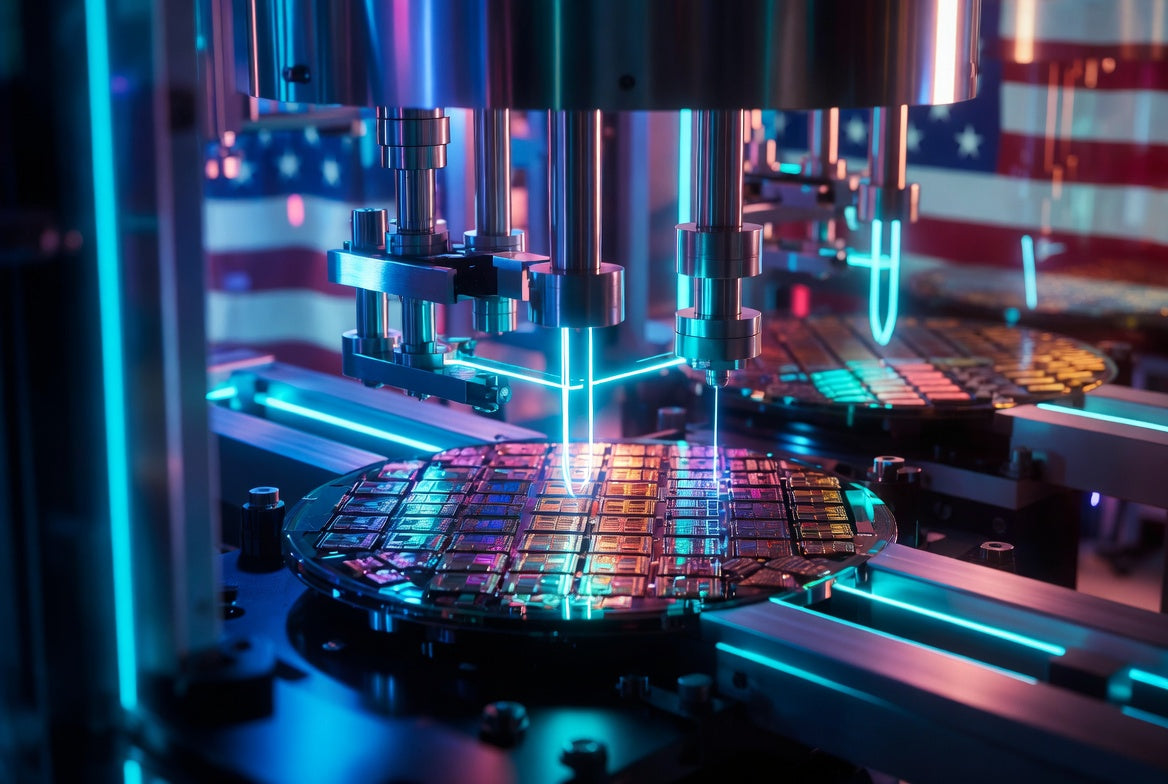
The U.S. Department of Commerce’s announcement on May 21, 2026, of Letters of Intent (LOIs) totaling $2.013 billion in CHIPS and Science Act incentives marks a decisive shift from research grants to serious domestic manufacturing infrastructure for quantum technologies.
The package targets two dedicated quantum foundries and seven leading quantum computing companies. It directly addresses the hardware bottlenecks that photonics engineers, laser system designers, and lab managers have been wrestling with for years: scalable fabrication of low-loss photonic integrated circuits, precision ion traps, neutral-atom arrays, and supporting cryogenic/optical packaging.
Foundry Backbone Takes Shape
IBM receives the largest slice — $1 billion — to launch Anderon, described as America’s first pure-play quantum chip foundry focused on quantum-grade superconducting wafers. IBM is matching with another $1 billion of its own capital plus IP and workforce contributions.
GlobalFoundries gets $375 million to establish a secure domestic quantum foundry supporting multiple modalities — superconducting, trapped-ion, photonic, topological, and silicon spin. This is particularly relevant for photonics teams, as GF has longstanding partnerships scaling photonic chipsets.
For optical engineers and photonics companies, the multi-modality approach signals growing demand for standardized processes around electro-optic materials (e.g., barium titanate for switches), high-temperature single-photon detectors, advanced packaging, and low-loss waveguides — components that must survive real manufacturing flows rather than lab prototyping.
Photonic and Trapped-Ion Players Gear Up
PsiQuantum ($100 million) will use the funds to accelerate manufacturability of its photonic quantum computing components, including BTO-based optical switches and advanced packaging. The company has partnered with GlobalFoundries since 2019 on silicon photonics production.
Quantinuum ($100 million) focuses on scaling fault-tolerant trapped-ion systems, explicitly planning deeper integration with onshore semiconductor and photonics suppliers (including GlobalFoundries and Monarch Quantum for integrated photonics).
Atom Computing and Infleqtion (each $100 million) target neutral-atom platforms, where laser control, optical addressing, and vacuum/photonics integration remain central engineering challenges.
Other recipients — Rigetti, D-Wave, and Diraq — round out coverage across superconducting and silicon-spin approaches.
What This Means for the Lab and Photonics Floor
For university research groups, national labs (Los Alamos, Sandia, Oak Ridge), and photonics vendors like TOPTICA, Edmund Optics, or Nu Quantum, this is concrete signal that capital is now flowing toward manufacturable solutions rather than heroic one-off demos.
Expect increased demand for:
- High-stability narrow-linewidth lasers and frequency combs for qubit control and readout
- Precision optical alignment and packaging processes compatible with semiconductor foundry flows
- Cryogenic photonics components and low-loss fiber coupling
- Test and measurement instrumentation rugged enough for production environments
The government is also taking non-controlling equity stakes in recipients, creating a tighter alignment between public strategy and private execution. This model reduces pure financial risk for scaling while giving the U.S. more direct leverage over strategic technology.
Bottom Line for Industry Professionals
This isn’t another broad policy statement. It’s the beginning of actual U.S. quantum wafer fabrication capacity coming online, with photonic and laser-based control systems deeply embedded in the roadmap.
Lab managers budgeting for 2027 equipment, photonics engineers designing next-gen optical interfaces, and quantum hardware teams writing proposals should factor in these emerging domestic supply chains. The friction points — yield on complex photonic circuits, laser reliability at scale, integration across modalities — are exactly what this funding aims to attack.
The race for utility-scale, fault-tolerant quantum systems just got significantly more grounded in American fabs.