
Major Breakthrough at EV Battery Plant: Handheld Fiber Laser Welding Replaces Entire MIG Lines
Handheld Fiber Laser Welding Breakthrough at Leading EV Supplier
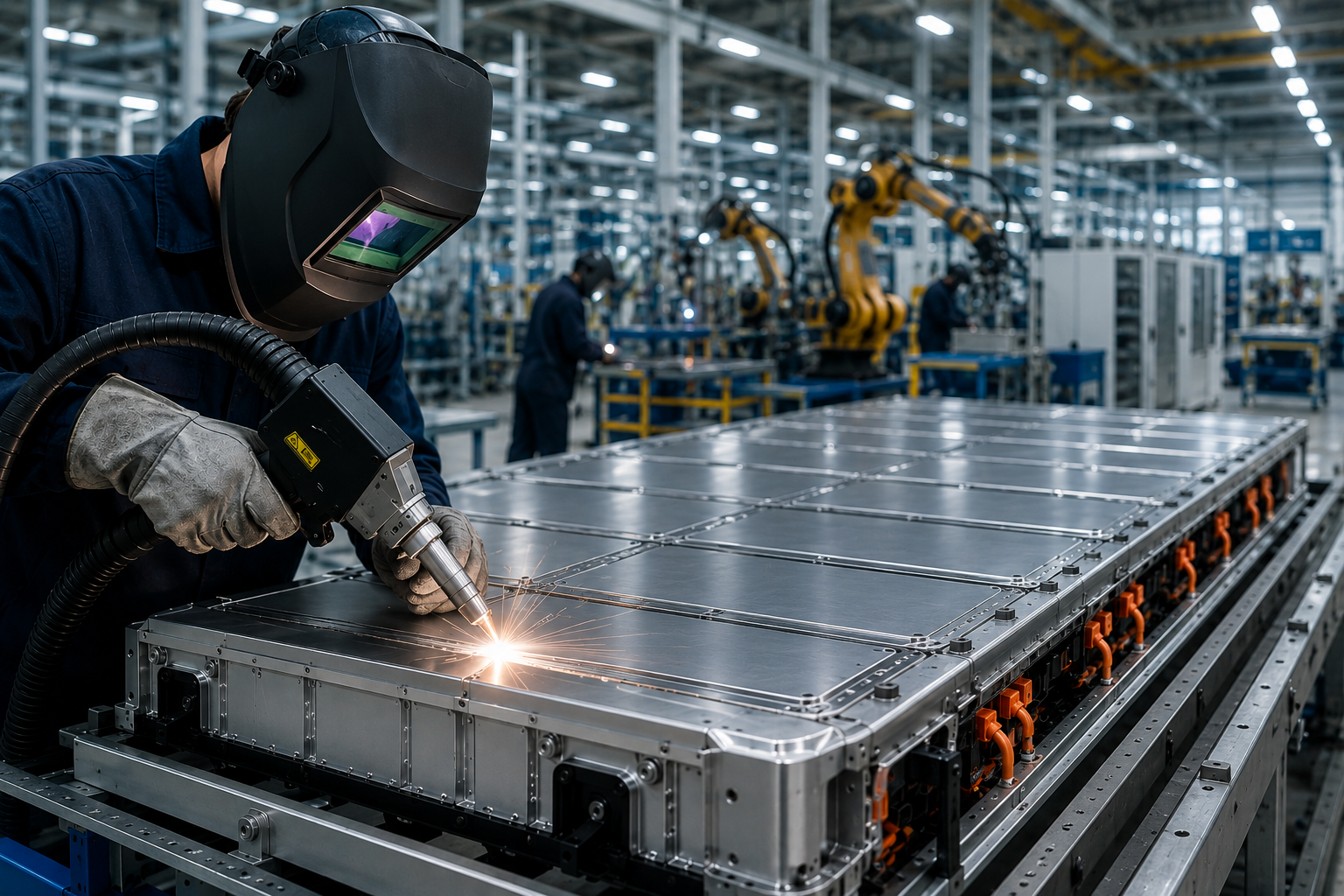
In a significant development making waves in manufacturing circles, a major North American EV battery supplier has successfully transitioned two full production lines from traditional MIG welding to handheld fiber laser welding systems. The move, completed in recent months, has delivered immediate and dramatic results on battery enclosure seams and structural components.
This targeted deployment marks one of the clearest real-world validations yet of handheld laser technology’s ability to outperform conventional methods in high-volume automotive environments.
What Happened at the Plant
The supplier, facing pressure to scale EV battery production while controlling costs, piloted 2 kW handheld fiber laser systems on enclosure welding stations. Within weeks, they expanded the trial after recording consistent gains. The lightweight laser heads, connected via flexible fiber cables, allowed operators to maneuver easily around large battery modules in ways MIG torches could not match.
The focused laser beam achieved deep penetration in a single pass with almost no distortion — a critical advantage when welding thin, coated high-strength steels used in EV enclosures.
Productivity Explosion on the Line
The most exciting outcome has been speed. Operators achieved travel speeds 3–5 times faster than their previous TIG setups and 2–3 times faster than MIG. Cycle times on key battery enclosure welds dropped by 50–65%, enabling the plant to increase daily output without adding shifts or floor space.
Because the laser creates a narrow heat-affected zone, parts stay flatter, reducing the need for rework and secondary straightening operations that previously slowed the line.
Sharp Drop in Consumables
The plant reported dramatic cost savings on consumables. MIG welding had required continuous filler wire, frequent tip replacements, and high gas flow rates. The new handheld laser systems primarily use lower volumes of shielding gas and only occasional lens protection.
Management shared that consumable spending per weld dropped approximately 70%, with significantly less spatter meaning much faster cleanup between parts. This has freed up maintenance technicians for other value-added work.
Faster Operator Ramp-Up
Training proved surprisingly straightforward. Welders with prior MIG experience reached production-level proficiency on the handheld lasers in just 10–15 days. The vendor-supplied program focused on practical skills: maintaining proper standoff distance, consistent travel speed, and angle control for different joint types.
This shorter learning curve helped the plant quickly staff the upgraded lines and reduce dependency on highly specialized TIG welders who are increasingly hard to find.
Ripple Effects Across Related End Markets
The success at the EV battery plant is already inspiring similar moves elsewhere:
- Automotive Component Suppliers: Several tier-1 suppliers are now evaluating handheld lasers for lightweight structural parts, drawn by the same low-distortion benefits that protect sensitive EV coatings.
- Aerospace MRO Shops: Repair facilities working on similar thin materials are piloting the technology for ducting and bracket repairs, excited by the potential for faster turnaround times on high-value components.
- Custom Fabrication: Job shops serving both automotive and aerospace clients report winning new contracts after demonstrating the clean, cosmetic welds possible with handheld lasers on stainless and aluminum prototypes.
- Contract Manufacturers: High-mix producers are adopting multi-function laser heads (weld + clean) to handle varied customer jobs more profitably and with quicker changeovers.
The breakthrough at the EV plant demonstrates that handheld fiber laser welding is no longer experimental — it is delivering tangible, production-floor wins right now.
Bottom Line
This EV battery supplier’s rapid and successful switch highlights the exciting momentum building behind handheld fiber laser welding. With major gains in speed, consumable savings, and training efficiency, more end-market leaders are expected to follow. For manufacturers under pressure to produce faster and cheaper without sacrificing quality, this specific deployment offers a compelling blueprint for what’s possible today.