
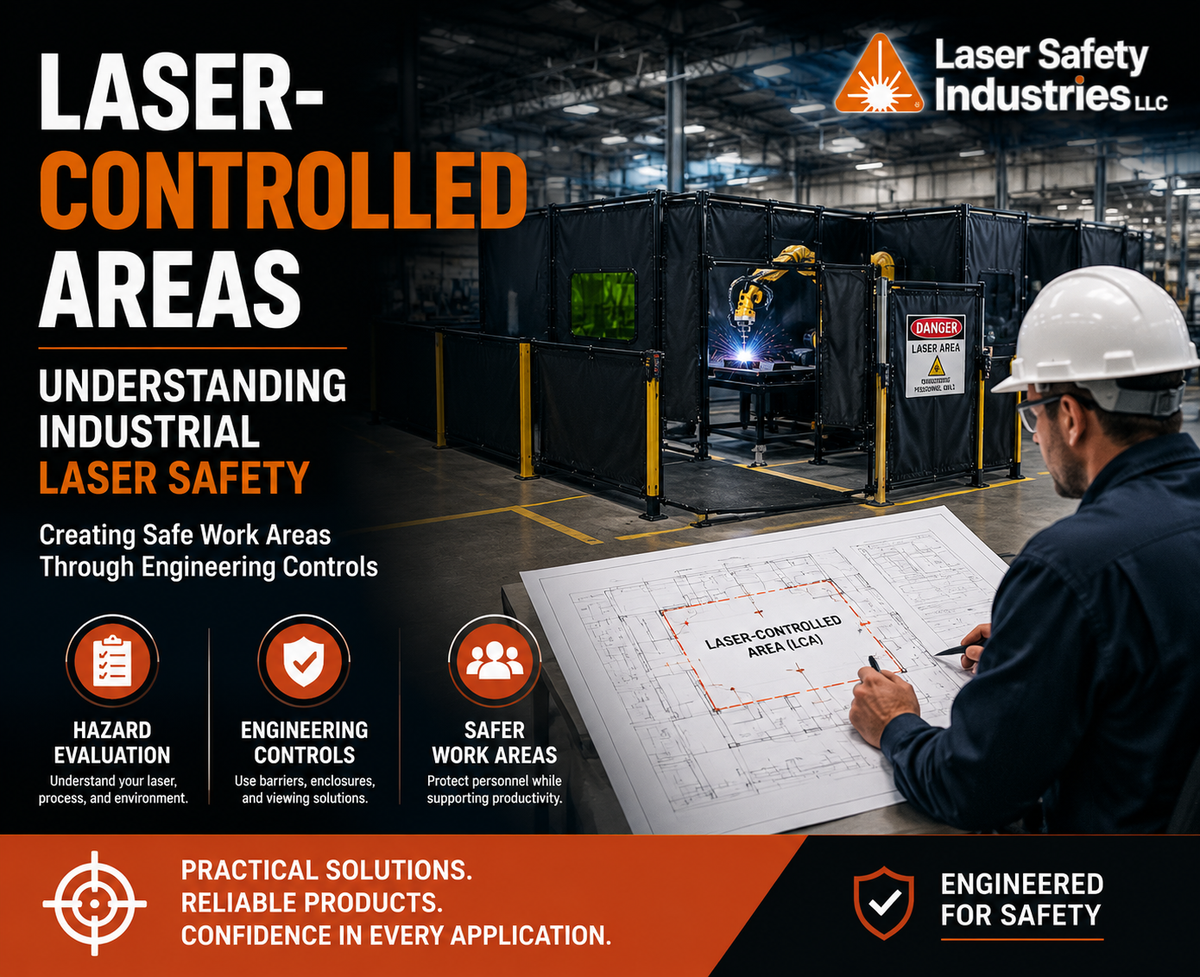
Laser Safety Industries Explains Laser-Controlled Areas and Their Role in Industrial Laser Safety at IMTS 2026
Helping Manufacturers Understand How Engineering Controls Create Safer Laser Work Environments
As industrial laser systems become more common in manufacturing, companies must consider how to create appropriate work areas that protect personnel while allowing efficient operation.
At IMTS 2026, Laser Safety Industries (LSI) will highlight the importance of properly designed Laser-Controlled Areas (LCAs) and how engineering controls can help manufacturers establish safer laser work environments.
What Is a Laser-Controlled Area?
A Laser-Controlled Area (LCA) is a designated area where access and safety controls are implemented to reduce the risk of exposure to hazardous laser radiation.
The purpose of an LCA is not simply to create a physical boundary—it is to establish an environment where laser hazards are properly evaluated and controlled.
The design of an LCA depends on factors including:
- Laser classification
- Laser wavelength
- Power level
- Beam path
- Operating procedures
- Personnel access
- Required engineering controls
Laser Safety Requires More Than a Product Selection
A common misconception is that laser safety begins with selecting a barrier or enclosure.
In reality, effective laser safety begins with understanding the application.
Manufacturers should evaluate:
- How the laser is being used
- Who may access the area
- Whether the process is automated or manual
- How personnel interact with the system
- What engineering controls are appropriate
The correct solution may involve barriers, enclosures, viewing systems, administrative controls, training, or a combination of these approaches.
Engineering Controls Within a Laser-Controlled Area
Engineering controls are often an important part of creating an effective laser-controlled area.
Examples may include:
Laser Safety Barriers
Barriers can help define the boundary of a laser work area and restrict access to hazardous radiation.
Protective Enclosures
For automated systems, protective housings or enclosed work cells may provide additional control over laser exposure.
Viewing Solutions
Laser safety windows and cameras can allow observation of processes while maintaining separation from the hazard.
Access Considerations
The design of entrances, openings, and operator access points should be considered as part of the overall safety approach.
Every Application Requires a Different Approach
There is no single laser safety solution that works for every manufacturing environment.
A robotic welding cell, handheld laser cleaning system, research application, and production laser process may each require different controls.
LSI works with manufacturers to evaluate their applications and identify practical solutions based on their specific operating conditions.
Supporting Manufacturers With Laser Safety Expertise
Laser Safety Industries provides more than laser safety products.
Through engineering reviews, technical resources, and application-focused guidance, LSI helps manufacturers better understand laser safety concepts and develop practical approaches for their operations.
LSI supports solutions including:
- Laser safety barriers
- Hardwall containment systems
- Softwall barrier systems
- Viewing windows
- Laser safety eyewear
- Portable containment solutions
Visit Laser Safety Industries at IMTS 2026
Attendees are invited to visit Laser Safety Industries at Booth 135236 during IMTS 2026 to discuss laser safety requirements and learn more about creating effective laser-controlled areas.
Whether implementing a new laser system or evaluating an existing process, the LSI team can help manufacturers better understand practical approaches to laser safety.
Visit Laser Safety Industries at Booth 135236 to discuss your industrial laser safety application.