
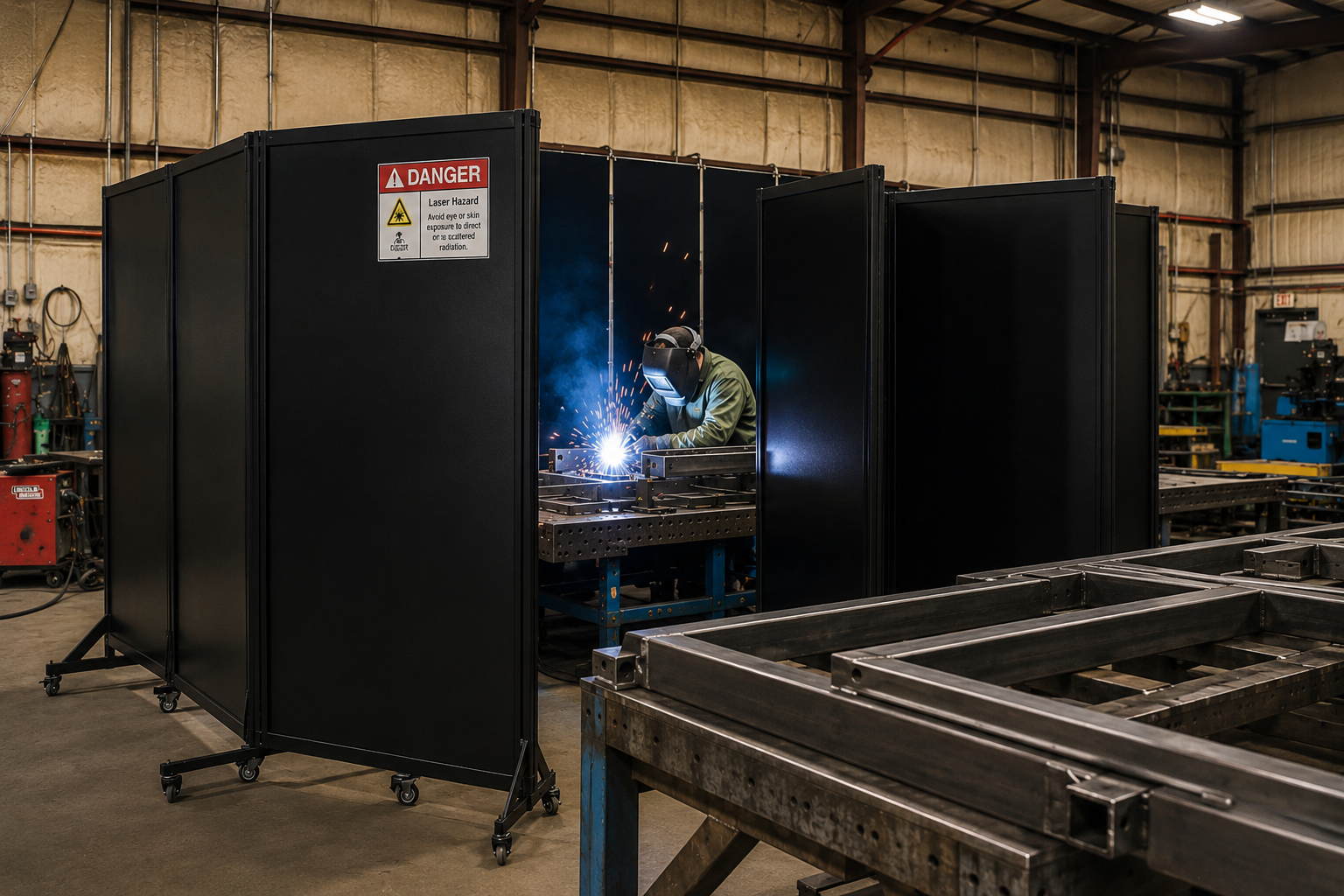
Supporting a Texas Fabrication Shop Transition Into Fiber Laser Welding
As handheld and industrial fiber laser welding systems continue to expand across fabrication and manufacturing environments, many shops face the same challenge:
How do you implement practical laser safety controls without overcomplicating operations?
Laser Safety Industries regularly works with fabrication shops, manufacturers, and welding operations transitioning into Class 4 fiber laser systems, helping customers balance safety, workflow, visibility, and production requirements.
The Situation
Frazier & Son, a Texas-based metal fabrication shop, was implementing IPG fiber laser welding systems within their operation and needed to safely contain a large welding area approximately 25' × 25'.
The shop required a solution that would:
-
support large workpieces and welding benches,
-
allow equipment and personnel movement,
-
integrate with existing workflows,
-
and maintain practical day-to-day usability for operators.
Because the operation involved large fabricated components and changing layouts, flexibility and scalability were critical considerations from the beginning.
The Challenge
Like many fabrication environments adopting laser welding technology, the customer needed to determine:
-
what level of containment was appropriate,
-
whether fixed walls or flexible barriers made more sense,
-
how to handle operator access,
-
and how to safely manage eyewear and observation requirements around fiber laser welding systems.
Our Approach
Laser Safety Industries worked directly with the customer to discuss the operational realities of the welding environment rather than simply recommending a one-size-fits-all solution.
Discussions included:
-
modular laser barrier curtain layouts,
-
collapsible hardwall barrier systems,
-
movable vs. fixed containment approaches,
-
welding booth configurations,
-
doorway access,
-
eyewear requirements,
-
and future expansion flexibility.
Because the customer already had fabrication capabilities in-house, Laser Safety Industries also discussed ways to integrate laser-rated materials into the customer’s existing framework designs to reduce unnecessary cost and complexity.
The project ultimately evolved into discussions around scalable modular systems that could expand alongside the customer’s welding operations over time.
Practical Guidance Instead of Overscoping
Throughout the process, Laser Safety Industries focused on helping the customer understand realistic exposure conditions and practical containment approaches.
During the discussions, Laser Safety Industries explained that many laser welding applications are primarily designed around controlling credible reflected and diffused exposure conditions within designated laser-controlled areas rather than assuming worst-case direct beam exposure at every point in the workspace.
This practical engineering approach allowed the customer to evaluate multiple containment options while maintaining operational flexibility for large fabricated components and changing workflows.
The Result
Frazier & Son moved forward with laser safety containment planning designed around their actual production environment rather than a rigid one-size-fits-all enclosure system.
The project also developed into an ongoing customer relationship involving additional discussions around:
-
modular laser containment systems,
-
welding layouts,
-
laser safety eyewear,
-
viewing windows,
-
and scalable future expansion options.
For Laser Safety Industries, projects like this reflect the importance of understanding how laser systems are actually used in real-world manufacturing environments — balancing safety, usability, workflow efficiency, and practical implementation.