Correctly Scoping the Actual Laser Hazard Saved an Estimated $800,000 Per Year
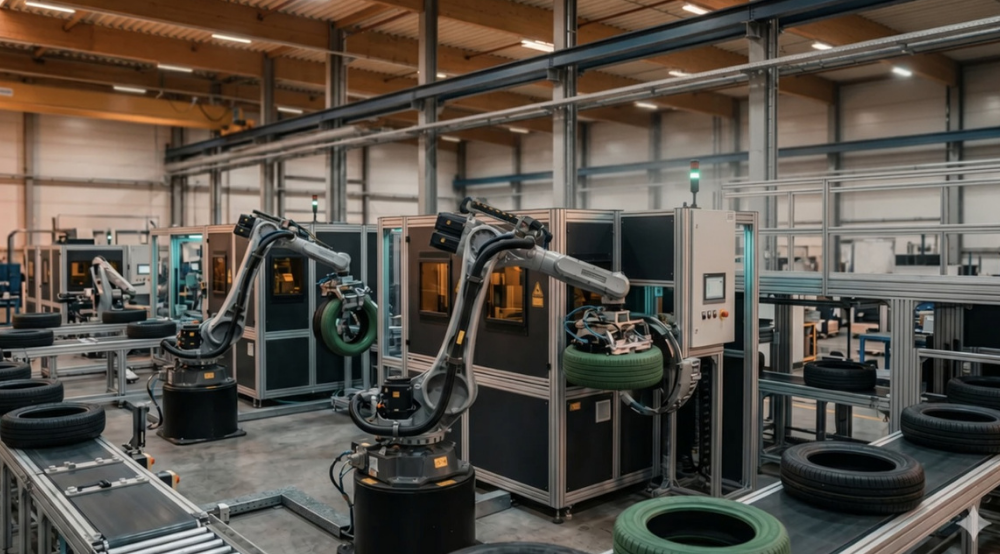
As Michelin modernized portions of its manufacturing operations over a multi-year period, the company needed to implement laser safety viewing protection across multiple production facilities.
Because portions of the manufacturing environment operated under labor union safety requirements, laser viewing materials needed to be deployed throughout the facilities to protect workers from low-level laser beam exposure conditions present within the production process.

Prior to working with Laser Safety Industries, Michelin had been quoted approximately $1 million annually for Class 4 dyed acrylic laser safety window systems as additional facilities were brought online.
After reviewing the actual application, Laser Safety Industries determined the environment did not involve the type of direct high-power exposure conditions requiring expensive Class 4 dyed acrylic laser window materials throughout the facilities.
Instead of overspecifying the application, Laser Safety Industries proposed a correctly scoped polycarbonate-based solution appropriate for the realistic hazard conditions present within the manufacturing environment.
The resulting system reduced annual deployment costs to approximately $200,000 per year while still meeting the practical safety requirements of the facilities.
Over the course of the multi-year retrofit effort, the solution remained operationally successful and ultimately saved Michelin several million dollars in projected laser safety material costs.
Correctly Scoping the Real Hazard Environment
This project reflects a broader engineering philosophy at Laser Safety Industries:
Effective laser safety is not about automatically selecting the highest-specification, most permanent, or most expensive solution available. The best long-term results come from correctly evaluating the actual operating conditions and matching the protection system to the realistic hazard environment.
 In many industrial applications, rigid hardwall systems or high-specification Class 4 materials are absolutely the correct solution. However, many manufacturing environments involve lower-level exposure conditions, partial containment requirements, retrofit installations, or evolving production layouts where a more flexible and properly scoped solution may be more practical.
Laser Safety Industries regularly evaluates applications where the original proposed containment approach significantly exceeded the realistic operational requirements of the environment.
In some containment projects, customers have received initial proposals exceeding $250,000 for rigid containment systems before Laser Safety Industries evaluated the actual operating environment and proposed more practical softwall or flexible containment approaches closer to the $80,000 range.

This does not necessarily mean the higher-specification system was incorrect — only that different engineering approaches can produce dramatically different operational and economic outcomes depending on how the real hazard environment is evaluated.
Because Laser Safety Industries manufactures many softwall and custom containment systems in-house, custom sewing, layout modifications, overlap geometries, and rapid deployment solutions can often be implemented significantly faster and more cost-effectively than traditional rigid containment approaches.
The goal is not to overspecify the environment.
The goal is to correctly scope the solution to the actual hazard conditions present within the application.